


Yesterday, I posted the non-fiction recommendations of books about American History that I should read in my post, Follow Up: Inspiration! Suggestions Needed! Today, I am continuing the list of recommendations I received from family, friends, and fellow bloggers with the fiction books that people suggested I read. I even got a few suggestions for books for The Netherlands!
If you have any books that are not the typical American History that we learn in school or books about your own country that you think are worthwhile reads, please share them with me! I'm going to be on a mission in 2011 to expose myself to new things!
All descriptions of the books come from Amazon.com unless otherwise noted.
Fiction
If you have any books that are not the typical American History that we learn in school or books about your own country that you think are worthwhile reads, please share them with me! I'm going to be on a mission in 2011 to expose myself to new things!
All descriptions of the books come from Amazon.com unless otherwise noted.
Fiction
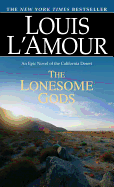
Left to die by his vengeful grandfather, rescued by outlaws, and raised by native Americans, Johannes Verne is strengthened by his love for two women and his ambition to survive on the Palm Springs desert.

A love story, an adventure, and an epic of the frontier, Larry McMurtry’s Pulitzer Prize— winning classic, Lonesome Dove, the third book in the Lonesome Dove tetralogy, is the grandest novel ever written about the last defiant wilderness of America. Journey to the dusty little Texas town of Lonesome Dove and meet an unforgettable assortment of heroes and outlaws, whores and ladies, Indians and settlers. Richly authentic, beautifully written, always dramatic, Lonesome Dove is a book to make us laugh, weep, dream, and remember.

What perfect timing for this optimistic, uplifting debut novel (and maiden publication of Amy Einhorn's new imprint) set during the nascent civil rights movement in Jackson, Miss., where black women were trusted to raise white children but not to polish the household silver. Eugenia Skeeter Phelan is just home from college in 1962, and, anxious to become a writer, is advised to hone her chops by writing about what disturbs you. The budding social activist begins to collect the stories of the black women on whom the country club sets relies and mistrusts enlisting the help of Aibileen, a maid who's raised 17 children, and Aibileen's best friend Minny, who's found herself unemployed more than a few times after mouthing off to her white employers. The book Skeeter puts together based on their stories is scathing and shocking, bringing pride and hope to the black community, while giving Skeeter the courage to break down her personal boundaries and pursue her dreams. Assured and layered, full of heart and history, this one has bestseller written all over it. (Feb.)
~Review by Publisher's Weekly (listed on Amazon.com) Copyright © Reed Business Information, a division of Reed Elsevier Inc. All rights reserved.

One Thousand White Women is the story of May Dodd and a colorful assembly of pioneer women who, under the auspices of the U.S. government, travel to the western prairies in 1875 to intermarry among the Cheyenne Indians. The covert and controversial "Brides for Indians" program, launched by the administration of Ulysses S. Grant, is intended to help assimilate the Indians into the white man's world. Toward that end May and her friends embark upon the adventure of their lifetime. Jim Fergus has so vividly depicted the American West that it is as if these diaries are a capsule in time.

Novel by John Steinbeck, published in 1939. Set during the Great Depression, it traces the migration of an Oklahoma Dust Bowl family to California and their subsequent hardships as migrant farm workers. It won a Pulitzer Prize in 1940. The work did much to publicize the injustices of migrant labor. The narrative, interrupted by prose-poem interludes, chronicles the struggles of the Joad family's life on a failing Oklahoma farm, their difficult journey to California, and their disillusionment once they arrive there and fall prey to a parasitic economic system. The insularity of the Joads--Ma's obsession with family togetherness, son Tom's self-centeredness, and daughter Rose of Sharon's materialism--ultimately gives way to a sense of universal community.
~The Merriam-Webster Encyclopedia of Literature --This text refers to the Unknown Binding edition.

In Jordan's prize-winning debut, prejudice takes many forms, both subtle and brutal. It is 1946, and city-bred Laura McAllan is trying to raise her children on her husband's Mississippi Delta farm—a place she finds foreign and frightening. In the midst of the family's struggles, two young men return from the war to work the land. Jamie McAllan, Laura's brother-in-law, is everything her husband is not—charming, handsome, and haunted by his memories of combat. Ronsel Jackson, eldest son of the black sharecroppers who live on the McAllan farm, has come home with the shine of a war hero. But no matter his bravery in defense of his country, he is still considered less than a man in the Jim Crow South. It is the unlikely friendship of these brothers-in-arms that drives this powerful novel to its inexorable conclusion.
The men and women of each family relate their versions of events and we are drawn into their lives as they become players in a tragedy on the grandest scale. As Kingsolver says of Hillary Jordan, "Her characters walked straight out of 1940s Mississippi and into the part of my brain where sympathy and anger and love reside, leaving my heart racing. They are with me still."

(recommended by Chelle at The Prairie Library)
Esperanza thought she'd always live with her family on their ranch in Mexico--she'd always have fancy dresses, a beautiful home, & servants. But a sudden tragedy forces Esperanza and Mama to flee to California during the Great Depression, and to settle in a camp for Mexican farm workers. Esperanza isn't ready for the hard labor, financial struggles, or lack of acceptance she now faces. When their new life is threatened, Esperanza must find a way to rise above her difficult circumstances--Mama's life and her own depend on it.

(recommended by Chelle at The Prairie Library)
Sherman Alexie tells the story of Junior, a budding cartoonist growing up on the Spokane Indian Reservation. Determined to take his future into his own hands, Junior leaves his troubled school on the rez to attend an all-white farm town high school where the only other Indian is the school mascot. Heartbreaking, funny, and beautifully written, The Absolutely True Diary of a Part-Time Indian, which is based on the author's own experiences, coupled with poignant drawings that reflect the character's art, chronicles the contemporary adolescence of one Native American boy as he attempts to break away from the life he thought he was destined to live.

In 1836, when she was nine years old, Cynthia Ann Parker was kidnapped by Comanche Indians. This is the story of how she grew up with them, mastered their ways, married one of their leaders, and became, in every way, a Comanche woman. It is also the story of a proud and innocent people whose lives pulsed with the very heartbeat of the land. It is the story of a way of life that is gone forever....
Fiction Novels based in The Netherlands
 Girl with a Pearl Earring - Tracy Chevalier (recommended by Leeswammes)
Set in 17th-century Delft, this historical novel intertwines the art of Johannes Vermeer with his life and that of a maiden servant in his household. From the few facts known about the artist, Chevalier creates the reality of The Netherlands. The parallell themes of tradesman/artist, Protestant/Catholic, and master/servant are intricately woven into the fabric of the tale. The painters of the day spent long hours in the studio devising and painting re-creations of everyday life. The thrust of the story is seen through the eyes of Griet, the daughter of a Delft tile maker who lost his sight and, with it the ability to support his family. Griet's fate is to be hired out as a servant to the Vermeer household. She has a wonderful sense of color, composition, and orderliness that the painter Vermeer recognizes. And, slowly, Vermeer entrusts much of the labor of creating the colored paints to Griet.

Fiction Novels based in The Netherlands

Set in 17th-century Delft, this historical novel intertwines the art of Johannes Vermeer with his life and that of a maiden servant in his household. From the few facts known about the artist, Chevalier creates the reality of The Netherlands. The parallell themes of tradesman/artist, Protestant/Catholic, and master/servant are intricately woven into the fabric of the tale. The painters of the day spent long hours in the studio devising and painting re-creations of everyday life. The thrust of the story is seen through the eyes of Griet, the daughter of a Delft tile maker who lost his sight and, with it the ability to support his family. Griet's fate is to be hired out as a servant to the Vermeer household. She has a wonderful sense of color, composition, and orderliness that the painter Vermeer recognizes. And, slowly, Vermeer entrusts much of the labor of creating the colored paints to Griet.
~Kristin M. Jacobi, Eastern Connecticut state University
~From Library Journal (on BN.com)

Tulip Fever - Deborah Moggach (recommended by Leeswammes)
In Tulip Fever, acclaimed author Deborah Moggach has created that rarest of novels--a literary tour de force that is also brilliantly, compulsively readable. Not since Patrick Suskind's Perfume has a work of fiction so vividly evoked a time, a place, and a passion.
In 1630s Amsterdam, tulip fever has seized the populace. Everywhere men are seduced by the fantastic exotic flower. But for wealthy merchant Cornelis Sandvoort, it is his young and beautiful wife, Sophia, who stirs his soul. She is the prize he desires, the woman he hopes will bring him the joy that not even his considerable fortune can buy.
Cornelis yearns for an heir, but so far he and Sophia have failed to produce one. In a bid for immortality, he commissions a portrait of them both by the talented young painter Jan van Loos. But as Van Loos begins to capture Sophia's likeness on canvas, a slow passion begins to burn between the beautiful young wife and the talented artist. As the portrait unfolds, so a slow dance is begun among the household's inhabitants. Ambitions, desires, and dreams breed a grand deception--and as the lies multiply, events move toward a thrilling and tragic climax.









 Posts
Posts


